
This commission is an institution that recommends prices to the Government of India after accounting for agricultural costs. Its recommendation is not the final decision. The recommendations of this commission go to the Prime Minister’s Committee on Economic Affairs, which, after considering these recommendations, announces the minimum support price of crops. This is only the minimum support price of the commodities, it is not written anywhere that it is a profitable price for the farmers. There are many obstacles in the way of the Agricultural Cost and Price Commission to determine this. The jurisdiction of its work is such that the commission can never do justice to the farmers. The government has tied its hands and feet within the jurisdiction of the commission itself.
It is recorded in the jurisdiction of the commission that while recommending the price of any commodity, it has to take special care that that price does not have much impact on the general prices and that there is no inflation affecting the common life. The commission has to take into account how much stock of that crop is in the government and the market. How much is it available in the world market. What is the trend of prices in the market? What is the demand and supply? What will be the impact on the prices of the industry? What is its price in the world? What is the cost of production of farmers. How have the prices of the items required for agriculture increased or decreased? What is the trend of the prices of common items in the market.
While calculating the agricultural expenses of farmers, the expenses of the workers hired by the farmers on daily wages etc., the rent of machinery on rent, the rent of land on contract, seeds, fertilizers, country-made manure fertilizer, irrigation expenses, diesel and electricity bills, which are incurred while running tube wells are taken into account. Apart from this, the expenses of the farmer himself and his family’s labor are also taken into account. The impact of the commercial conditions of the agricultural and non-agricultural sectors and the recommended price of the crop on the economy of the country is also taken into account. After taking these things into account, the price has to be recommended by adding 50% more to the total cost.
Agriculture is also a commercial business. Its production costs are high these days. Inflation does not only happen with farmers’ products. The government increases the prices of diesel and petrol. With that, transport costs increase, which causes inflation. The government increases GST, which also causes inflation. Why punish farmers for it? The war between Ukraine and Russia had an impact on the world market, inflation increased, will the farmers be punished? Today, there is a shortage of food grains in the world market, the government banned the export of wheat. By increasing the price for the export of basmati, its price fell in the Indian market. The government’s announcement to reduce customs duty for the import of wheat and import it put a brake on the increase in the price of wheat. The government is earning lakhs of crores every year by imposing taxes on diesel and petrol, which causes inflation. The farmers are being punished for this? The government controls all these phenomena. What is the connection between the industry’s expenses and the farmers? Why does the government make farmers suffer under the guise of its responsibilities? With such conditions on the commission, profitable prices can never be fixed for the farmers.
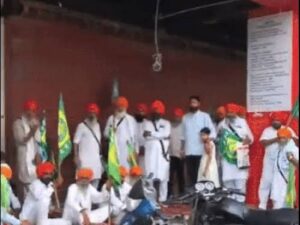
We surrounded the Punjab Raj Bhavan in Chandigarh from March 12 to March 14, 1984. Apart from accepting the demands of the farmers, the then Governor Mr. B. D. Pandey formed a committee under the leadership of S. Sardara Singh Johal regarding the electricity rates etc. applicable at that time for agriculture. This committee wrote in its report submitted to the government at that time that ‘it has been more than a decade that the government has been continuously squeezing the profits of the farmers by fixing low prices.’ That is, since 1976, farmers have been continuously squeezed by paying low prices. Similarly, S. Parkash Singh Badal formed a committee of economists under the leadership of Dr. Ranjit Singh Ghuman in 2007. This committee linked the prices of wheat and paddy to the price index for the farmers of Punjab and submitted a report to the Punjab government in 2008 regarding their prices. This committee wrote in its report that ‘the Central Government looted Rs. 61696 crore from the farmers of Punjab by fixing low prices for only two crops of wheat and paddy.’ If we look at this amount by adding bank interest, then this amount will be more than the debt incurred by the farmers of Punjab. This is the account of only two crops. If we look at the accounts of sugarcane, cotton, pulses, oil seeds, potatoes, fruits and vegetables, etc., then this amount will be at least more than two lakh crores. The farmers have a debt of half this, i.e. one lakh crore. It is clear that the farmers are not to blame for the debt incurred by the farmers. This is solely the result of the government’s anti-farmer policies. Farmers are generally semi-educated or illiterate. Farmers do not know the methods of determining the MSP of their commodities and the government conspiracies. There are many farmers among us who blame the farmer for the debt.
Governments are always concerned about inflation in the market. Inflation is also of the things that the farmer produces. Since the start of the Green Revolution, the government has not increased the price of any agricultural commodity more than 30 times. The price of diesel required for agriculture has increased from 87 paise per liter to 89 rupees per liter, i.e. 110 times, the prices of fertilizers have also increased from 110 to 140 times. The price of agricultural machinery has increased by 60 to 70 times. The salary of employees has increased by 600 times. The government increases GST, this causes inflation, so the farmer is punished. The farmer is punished for every government decree, which increases government expenditure, i.e. inflation.
Whenever the government
When the government announces a price, it announces that price as the minimum support price, not as a profit-making price. Still, there is no guarantee that every commodity will be sold at the MSP fixed by the government. The official fixed price of moong dal is Rs 8682 per quintal, but in the market it is sold for Rs 5500 to Rs 6300. The fixed price of sunflower is Rs 7280, but in the market it is not sold for more than Rs 5500. There is an uproar among farmers in states like Maharashtra and Karnataka, which produce tur dal. Its official MSP is Rs 7550, but in the market no one asks even Rs 4000. But the consumer buys the same tur dal for Rs 160 per kg, i.e. Rs 16000 per quintal. A moong trader buys for Rs 6,000 and sells for Rs 10,000 per quintal. The same is the case with oilseeds. Our government spends Rs 3.5 lakh crore every year to import pulses and edible oil from abroad through its beloved Adanis. If the government makes a law to guarantee MSP to its own farmers and ensures their purchase of oilseeds and pulses, then our farmers will make the country self-reliant in pulses and oilseeds within two years.
The biggest problem is that the government, while supporting corporate houses, puts the burden of its responsibilities and inflation on the farmers, wants to keep the farmers trapped in economic depression and poverty. The more you dig into this issue, the more it will spread like a leaf in a bag, but there will be no solution, because the farmers are illiterate and unorganized and the government is dishonest. The government keeps the farmers in a state of disarray and poverty. He has interests in this. The farmer doesn’t understand.